


The
CIA Tortured Humans and Experimented on Them
The
CIA Tortured Humans and Experimented on Them
Be a
Proud American
The CIA Didn’t
Just Torture, It Experimented on Human Beings
Reframing the
CIA’s interrogation techniques as a violation of scientific and medical ethics
may be the best way to achieve accountability.
By Lisa Hajjar
DECEMBER
16, 2014
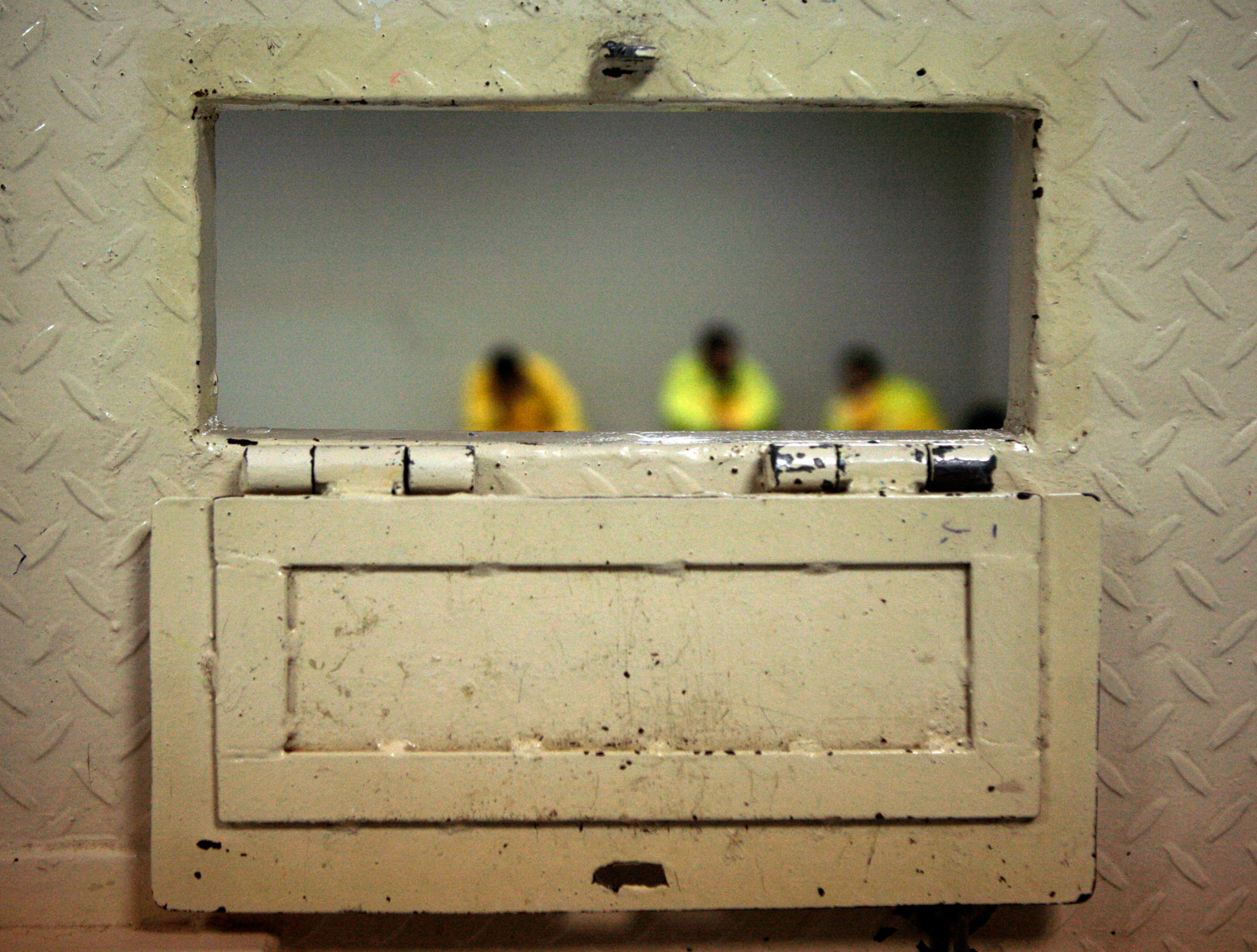
(AP Photo/Maya
Alleruzzo, File)
Human experimentation was a
core feature of the CIA’s torture program. The experimental nature of the
interrogation and detention techniques is clearly evident in the Senate
Intelligence Committee’s executive summary of its investigative report, despite
redactions (insisted upon by the CIA) to obfuscate the locations of these
laboratories of cruel science and the identities of perpetrators.
At the helm of
this human experimentation project were two psychologists hired by the CIA,
James Mitchell and Bruce Jessen. They designed interrogation and detention
protocols that they and others applied to people imprisoned in the agency’s
secret “black sites.”
In its response
to the Senate report, the CIA justified its decision to hire the duo: “We
believe their expertise was so unique that we would have been derelict had we
not sought them out when it became clear that CIA would be heading into the
uncharted territory of the program.” Mitchell and Jessen’s qualifications did
not include interrogation experience, specialized knowledge about Al Qaeda or
relevant cultural or linguistic knowledge. What they had was Air Force
experience in studying the effects of torture on American prisoners of war, as
well as a curiosity about whether theories of “learned helplessness” derived
from experiments on dogs might work on human enemies.
To implement
those theories, Mitchell and Jessen oversaw or personally engaged in techniques
intended to produce “debility, disorientation and dread.” Their “theory” had a
particular means-ends relationship that is not well understood, as Mitchell
testily explained in an interview on Vice News: “The point of the bad cop is to
get the bad guy to talk to the good cop.” In other words, “enhanced
interrogation techniques” (the Bush administration’s euphemism for torture) do
not themselves produce useful information; rather, they produce the condition
of total submission that will facilitate extraction of actionable intelligence.
Mitchell, like
former CIA Director Michael Hayden and others who have defended the torture
program, argues that a fundamental error in the Senate report is the elision of means (waterboarding,
“rectal rehydration,” weeks or months of nakedness in total darkness and
isolation, and other techniques intended to break prisoners) and ends—manufactured
compliance, which, the defenders claim, enabled the collection of abundant
intelligence that kept Americans safe. (That claim is amply and authoritatively
contradicted in the report.)
As Americans from
the Beltway to the heartland debate—again—the legality and efficacy of
“enhanced interrogation,” we are reminded that “torture” has lost its stigma as
morally reprehensible and criminal behavior. That was evident in the 2012 GOP
presidential primary, when more than half of the candidates vowed to bring back
waterboarding, and it is on full display now. On Meet the Press,
for example, former Vice President Dick Cheney, who functionally topped the
national security decision-making hierarchy during the Bush years, announced
that he “would do it again in a minute.”
No one has been
held accountable for torture, beyond a handful of prosecutions of low-level
troops and contractors. Indeed, impunity has been virtually guaranteed as a
result of various Faustian bargains, which include “golden shield” legal memos
written by government lawyers for the CIA; ex post facto immunity for war
crimes that Congress inserted in the 2006 Military Commissions Act;
classification and secrecy that still shrouds the torture program, as is
apparent in the Senate report’s redactions; and the “look forward, not
backward” position that President Obama has maintained through every wave of
public revelations since 2009. An American majority, it seems, has come to
accept the legacy of torture.
Human
experimentation, in contrast, has not been politically refashioned into a
legitimate or justifiable enterprise. Therefore, it would behoove us to
appreciate the fact that the architects and implementers of black-site torments
were authorized at the highest levels of the White House and CIA to experiment
on human beings. Reading the report through this lens casts a different light
on questions of accountability and impunity.
The “war on
terror” is not the CIA’s first venture into human experimentation. At the dawn
of the Cold War, German scientists and doctors with Nazi records of human
experimentation were given new identities and brought to the United States
under Operation Paperclip. During the Korean War, alarmed by the shocking
rapidity of American POWs’ breakdowns and indoctrination by their communist
captors, the CIA began investing in mind-control research. In 1953, the CIA
established the MK-ULTRA program, whose earliest phase involved hypnosis,
electroshock and hallucinogenic drugs. The program evolved into experiments in
psychological torture that adapted elements of Soviet and Chinese models,
including longtime standing, protracted isolation, sleep deprivation and
humiliation. Those lessons soon became an applied “science” in the Cold War.
During the
Vietnam War, the CIA developed the Phoenix program, which combined
psychological torture with brutal interrogations, human experimentation and
extrajudicial executions. In 1963, the CIA produced a manual titled “Kubark
Counterintelligence Interrogation” to guide agents in the art of extracting
information from “resistant” sources by combining techniques to produce
“debility, disorientation and dread.” Like the communists, the CIA largely
eschewed tactics that violently target the body in favor of those that target
the mind by systematically attacking all human senses in order to produce the
desired state of compliance. The Phoenix program model was incorporated into
the curriculum of the School of the Americas, and an updated version of the
Kubark guide, produced in 1983 and titled “Human Resource Exploitation Manual,”
was disseminated to the intelligence services of right-wing regimes in Latin
America and Southeast Asia during the global “war on communism.”
In the mid-1980s,
CIA practices became the subject of congressional investigations into
US-supported atrocities in Central America. Both manuals became public in 1997
as a result of Freedom of Information Act litigation by The Baltimore
Sun. That would have seemed like a “never again” moment.
But here we are
again. This brings us back to Mitchell and Jessen. Because of their experience
as trainers in the military’s Survival, Evasion, Resistance, Escape (SERE)
program, after 9/11 they were contacted by high-ranking Pentagon officials and,
later, by lawyers who wanted to know whether some of those SERE techniques
could be reverse-engineered to get terrorism suspects to talk.
The road from
abstract hypotheticals (can SERE be reverse-engineered?) to the authorized use
of waterboarding and confinement boxes runs straight into the terrain of human
experimentation. On April 15, 2002, Mitchell and Jessen arrived at a black site
in Thailand to supervise the interrogation of Abu Zubaydah, the first
“high-value detainee” captured by the CIA. By July, Mitchell proposed more
coercive techniques to CIA headquarters, and many of these were approved in
late July. From then until the program was dry-docked in 2008, at least
thirty-eight people were subjected to psychological and physical torments, and
the results were methodically documented and analyzed. That is the textbook
definition of human experimentation.
My point is not
to minimize the illegality of torture or the legal imperatives to pursue
accountability for perpetrators. Rather, because the concept of torture has
been so muddled and disputed, I suggest that accountability would be more
publicly palatable if we reframed the CIA’s program as one of human
experimentation. If we did so, it would be more difficult to laud or excuse
perpetrators as “patriots” who “acted in good faith.” Although torture has
become a Rorschach test among political elites playing to public opinion on the
Sunday morning talk shows, human experimentation has no such community of
advocates and apologists.


/https://www.niagarafallsreview.ca/content/dam/thestar/news/canada/2021/09/25/huawei-executive-meng-wanzhou-receives-warm-welcome-upon-return-to-china/_1_meng_wanzhou_2.jpg)





No comments:
Post a Comment
Note: Only a member of this blog may post a comment.