Paul Craig Roberts Translations

What part will your country play in World War III?


CROATIAN   ENGLISH   GREEK   NEDERLANDS   POLSKI   PORTUGUESE   ROMANIAN  SPANISH  РУССКИЙ

What part will your country play in World War III?

By Larry Romanoff

The true origins of the two World Wars have been deleted from all our history books and replaced with mythology. Neither War was started (or desired) by Germany, but both at the instigation of a group of European Zionist Jews with the stated intent of the total destruction of Germany. The documentation is overwhelming and the evidence undeniable. (1) (2) (3) (4) (5) (6) (7) (8) (9) (10) (11)

That history is being repeated today in a mass grooming of the Western world’s people (especially Americans) in preparation for World War III – which I believe is now imminent. 

READ MORE


Thursday, September 27, 2018

EN -- Manlio Dinucci - « THE ART OF WAR » THE STRATEGY OF DEMONISING RUSSIA


« THE ART OF WAR »

THE STRATEGY OF DEMONISING RUSSIA
by Manlio Dinucci

The government contract, adopted last May by the Five Stars Movement and the League, confirms that Italy considers the United States its « privileged ally ». A link which was reinforced by Prime Minister Giuseppe Conte who, at his meeting with President Donald Trump in July, established with the USA « a strategic cooperation, almost an exercise of twinning, by virtue of which Italy will become a privileged interlocutor of the United States for the principal challenges which must be faced ». However, at the same time, the new government signed a contract declaring an « opening to Russia, which should be perceived not as a menace, but as an economic partner » and even as a  « potential partner for NATO ». Rather like persuading the devil to feel good about holy water.
In this way, both the government and the opposition can ignore the US strategy of demonising Russia, which is aimed at creating the image of a dangerous enemy against whom we must prepare to fight.
This strategy was exposed, in a hearing at the Senate, by Wess Mitchell, vice-secretary of the State Department for European and Eurasian Affairs. « In order to stand up to the Russian menace, US diplomacy must be backed up by a military power which is second to none and fully integrated with our allies and all our instruments of power » [1].
Increasing its military budget, the United States began to « recapitalise the nuclear arsenal », including new B61-12 nuclear bombs, which, from 2020, will be deployed in Italy and other European countries against Russia.
The United States, specifies the vice-secretary, have spent 11 billion dollars since 2015 (this will rise to 16 billion in 2019) for the « European Dissuasion Initiative », in other words to potentialise their military presence against Russia in Europe.
Inside NATO, they have managed to force an increase of more than 40 billion dollars in the military spending of their European allies, and establish two new command centres, including one situated in the USA for the Atlantic, to defend against « the threat of Russian submarines ». In Europe, the United States give particular support to « the States along the front line », like Poland and the Baltic countries, and they have cancelled the restrictions to the supply of weapons to Georgia and Ukraine (that is, the States which, with the aggression against South Ossetia and the Place Maïdan putsch, triggered the US and NATO escalation against Russia).
The representative from the State Department accused Russia not only of military aggression, but also, in the United States and in the European states, of operating « psychological mass campaigns against the population in order to destabilise the society and the government ». In order to implement these operations, which are part of the « continual effort by the Putin mechanism for international domination », the Kremlin uses the « panoply of subversive policies once employed by the Bolsheviks and by the Soviet state, updated for the digital age ».
Wess Mitchell accused Russia of techniques in which the USA excel – they have 17 federal agencies for espionage and subversion, including the State Department. It was this same organisation which has just created a new figure - « Senior Advisor for Russian Malign Activities and Trends » [2] - charged with developing inter-regional strategies. On these bases, the 49 diplomatic US missions in Europe and Eurasia must set up, in their respective countries, specific plans of action against Russian influence.
We do not yet know what the US embassy's plan of action may be in Italy. But as the « privileged interlocutor of the United States », Prime Minister Conte must know what it is. He should communicate this knowledge to the Parliament and the nation, before the « evil activities » of Russia destabilise Italy.

il manifesto, September 25, 2018

Translator: Peter Kimberley


[1] “Statement of A. Wess Mitchell at the US Senate Foreign Relations Committee”, by A. Wess Mitchell, Voltaire Network, 21 August 2018.
[2] Senior advisor for Russian Malign Activities and Trends, or SARMAT, which is also the name of the latest Russian intercontinental missile. Amused reaction by the spokesperson for Russian Minister for Foreign Affairs - « It's a violation of the author's rights », declared Mme Zakharova.

NO WAR NO NATO

Tuesday, September 25, 2018

THIERRY MEYSSAN -- Will London, Paris, and Tel-Aviv be sanctioned by Moscow and Washington?

Will London, Paris, and Tel-Aviv be sanctioned by Moscow and Washington?

The confrontation which recently occurred in Lattakia may result in a complete global redistribution of the cards. There are two reasons for this, the second of which is being hidden from the Western world. First of all, it cost the lives of 15 Russian soldiers; secondly, it not only implicates Israël, but also the United Kingdom and France. This is potentially the most dangerous crisis in more than 60 years. We now have to find out whether President Trump, currently in the middle of his election campaign, is capable of supporting his Russian counterpart, in order that the United States and Russia may sanction the colonial powers as they did in 1956, during the Suez crisis.
 | DAMASCUS (SYRIA)  
JPEG - 47.4 kb
Moscow, 20 September 2018 - the Chief of Staff for the Israëli Air Force, General Amikam Norkin, arrives in a hurry to present his version of events. Once these proofs were checked and compared with other recordings, it transpired that Israël was lying straight-faced.
On 17 September 2018, France, Israël and the United Kingdom carried out a joint operation against Syrian targets. During the brief moments of combat, a Russian reconnaissance plane was brought down by Syrian ’friendly fire’. Study of the recordings shows that an Israëli F-16 had flown hidden behind the Ilyushin Il-20 in order to confuse the Syrian Air Defences.
The destruction of a Russian military aircraft by the fault of Israël, during a joint operation by the United Kingdom, France and Israël, caused consternation in all the chancelleries. Since the start of hostilities in Syria seven years ago, if there were a ’red line’, it was that the different protagonists should never endanger Russian, US, or Israëli forces.
We are sure about very little of what actually happened, except that :
- a British Torpedo took off from Cyprus to land in Iraq. During the flight, it violated Syrian air space in order to scan the Syrian defences and make the allied attack possible.
- less than an hour later, four Israëli F-16s and a French frigate, L’Auvergne, fired on targets in the Syrian governorate of Lattakia. The Syrian air defences protected their country by firing their S-200s against the French and Israëli missiles.
- During the battle, an F-16 used a Russian Ilyushin Il-20 as a shield. The Ilyushin was flying a surveillance mission over the area, localising jihadist drone launch sites. The Syrian defences fired a missile, aiming for the thermal signal of the Israëli aircraft. Theoretically, therefore, it could have destroyed the Russian plane by mistake.
This is, however, implausible, because S-200 missiles are equipped with a reconnaissance system able to distinguish between friendly and enemy targets, which the Russian Minister for Defence successively confirmed, then denied. In any case, the Ilyushin was destroyed, without our knowing for certain how, or by whom.
The cowardice of the British and French leaders led them to censor all information concerning their responsibility in this operation. London made no comment, and Paris denied the facts. Neither the BBC, nor France-Television dared to mention the subject. For these two countries, more than ever, the reality of external politics is excluded from the democratic debate.

Immediate interpretation of the events

We do not know if the destruction of the Russian aircraft (causing the death of the 15 men on board) can be blamed on the Israëli pilot - which seems highly unlikely - on the Israëli army, or on the alliance which carried out the attack.
On the answer to this question hangs the possibility of conflict between four nuclear powers. The situation is therefore extremely serious. It has no precedent since the creation of the Russian Federation, at the end of 1991.
The British-French-Israëli aggression is the response by these three countries to the Russian-Turkish agreement signed only a few hours earlier at Sotchi. It came into play after the US refusal, at the beginning of September, to bomb Syria under false pretences, and the sending of a US delegation into the Arab world in order to express its disagreement with the British-French initiatives [1].
The Sotchi agreements were signed by Turkey under intense pressure from Russia. In Teheran, President Recep Tayyip Erdoğan had refused to sign the Memorandum concerning the withdrawal of the jihadist and Turkish forces in Idlib. This had not pleased President Vladimir Putin, who answered first of all by reaffirming the sovereignty and territorial integrity of Syria [2] and, furthermore, by underlining for the first time the illegitimacy, under international law, of the Turkish military presence in the country. Ten days later, a very unsettled Mr, Erdoğan accepted an invitation to Russia.
The Sotchi agreement, while distancing Turkey a little further from NATO with its energy contracts, forced Ankara de facto to withdraw from a part of the territory that it occupies, allegedly to better protect the pseudo-« rebels » gathered in the governorate of Idlib [3]. Besides this, Turkey only has one month in which to confiscate the heavy weaponry of its friends from Al-Qaïda and Daesh in the demilitarised zone [4].
This agreement was obviously unacceptable for London, Paris and Tel-Aviv :
- in the end, it plans for the disappearance of the jihadists as an army, while London has been supervising, training and manipulating them for decades [5] ;
- the end of the dream of a French mandate over Syria and of the creation of a new French colony in the North of the country, under the phoney name of Kurdistan (Kurdistan is legitimate only within the frontiers which were recognised by the Sèvres Conference, in 1920.) In other words, not in Iran, nor Iraq or Syria, but only in what is now known as Turkey [6]).
- the end of the regional domination of Israël, faced with a stable Syria under Russian protection.

Mid-term interpretation of the events

The British-French-Israëli military alliance has not entered into action since the Suez Canal crisis in 1956. At that time, Anthony Eden, Guy Mollet and David Ben Gourion joined their forces in order to humiliate the Arab nationalists, particularly the Egyptian Gamal Abdel Nasser, and to re-establish the British and French colonial empires (« Operation Musketeer »).
This is exactly what happened with this new attack : as was confirmed by the Secretary General of Hezbollah, Hassan Nasrallah, none of the targets under attack were linked in any way to Iran or Hezbollah. This British-French-Israëli action had nothing to do with the international struggle against the jihadists in general and Daesh in particular. It also had no connection with the overthrow of the Syrian Arab Republic or its President, Bachar el-Assad. Its main objective was to kill military scientists, in particular the rocket specialists from the Institute of Technical Industries in Lattakia.
This is therefore the resumption and continuation of the policy of targeted assassinations waged by Israël for the last twenty years, successively against the Iraqi, Iranian, and now Syrian scientists. It is one of the pillars of colonial policy : to prevent the submitted populations from attaining the same level of education as their masters. In former times, the Westerners forbade their slaves from learning to read under pain of death. Today, they eliminate their scientists.This policy was relaunched with the British-French-US bombing of 14 April 2018, in which the only target destroyed was the Scientific Research Centre in Barzeh [7], then with the breakdown of the 5+1 agreement with Iran (JCPoA) which forced the country to close its nuclear physics faculties (May 8, 2018).
It was a joint initiative : the jihadists destroy the past, the Westerners destroy the future.

Long-term interpretation of the events

Since the deployment of Russian troops in Syria, on 13 September 2015, to help Syria in its fight against the terrorists, the allies of the United States have understood the impossibility of carrying out the US plan without risking a world war. With the arrival of Donald Trump at the White House, they have progressively questioned their war objectives, abandoned the plans of the « Friends of Syria » and fallen back on their respective historical strategies [8].
It is this logic that led them to reform the alliance which provoked the Suez crisis, and it is this same logic which pushed Germany to distance itself from them.
At the beginning of the First World War, the British, French and Russian empires decided on the partition of the world which they would implement as soon as they had gained victory. The treaty was negotiated by Mark Sykes, Georges Picot and Sergueï Sazonov. During the course of the World War, however, the Tsar was overthrown by the Bolcheviks, which meant that the areas of the world originally reserved for the Russian empire were once again up for grabs. Finally, at the end of the World War, only the part of the plan relative to the Middle East was applied, under the name of the « Sykes-Picot » agreement.
The return of Russia to the international game obviously brings into question the British-French colonial sharing of the Middle East. The foreseeable clash has just occurred, either accidentally or deliberately, with the destruction of the Ilyushin Il-20 during the joint British-French-Israëli military operation.

How to react

The bewilderment of the international community in the face of this brutal awakening of a century-old conflict can be measured by the Twitter silence from the White House.
During the Suez crisis, the Israëli troops engaged were twice as numerous as all the British and French forces together. The total number of coalition forces was about 250,000 men. This was therefore a very large-scale operation compared to that of Lattakia. But it remains true that the two sequences work from the same diplomatic logic, and may lead to the same developments.
During the Suez crisis, in the middle of the Cold War, the Soviet Union threatened the United Kingdom, France, and Israël with a nuclear riposte if they refused to withdraw from Egypt. At first, NATO supported the Europeans in threatening Moscow with a World War, before changing its mind. In the middle of the Cold War, therefore, the United States temporarily supported the USSR in order to halt the European folly.
For Washington, allowing the Europeans to pursue their plans was the equivalent of pushing all the Arab nations into the arms of the Soviets. Apart from that, it simply was not feasible to accept the French-British intervention at the same time as they were denouncing the repression of the Hungarian revolution by the Warsaw Pact.
President Dwight D. Eisenhower and Vice-President Richard Nixon launched a monetary attack against the pound sterling, sent their naval and airborne forces to interfere with the British-French-Israëli complex, and forbade the use of French military material financed by US funds.
International peace was preserved thanks to certain third parties such as the Secretary General of the UNO, Dag Hammarskjöld (who was assassinated three years later, and was posthumously awarded the Nobel Peace Prize); the Canadian Minister for Foreign Affairs Lester B. Pearson (who also received the Nobel Peace Prize); and the leader of the non-aligned nations and Prime Minister of India, Jawaharlal Nehru.
The Suez crisis profoundly upset not only international political life, but also the national reality of the United Kingdom, France and Israël.
- Circumventing the European vetos at the Security Council, the UNO General Assembly called for the withdrawal of the invaders and created the first United Nations intervention force.
- In the United Kingdom, the House of Commons demanded the end of colonial politics to the profit of the promotion of the economic interests of London via the Commonwealth.
- In France, the Communists, the Gaullists and the Poujadists (including Jean-Marie Le Pen) united against the Centrists and the Socialists; a configuration that has never been seen since. Six years later, President De Gaulle considered that by recognising the independence of Algeria, he would put an end to military collaboration with the colonial state of Israël and restore the policy of friendship and collaboration with the Arab peoples, which had always characterised France, apart from its colonial period [9].
The position of the Western powers concerning the aggression on Lattakia is all the more difficult because, in violation of their agreement with Russia, the Israëlis only informed Moscow of their operation a long time after it had begun, and only one minute before they began firing. As for the Pentagon, they affirmed that they had not been warned at all. But let us not forget that the Israëli-Russian mutual non-aggression pact in Syria only exists because Israël is the US arsenal for the Middle East, housing (with Italy) the stocks of US weaponry for the entire region. If Israël truly did not inform the Pentagon of its actions in advance, then it can not benefit from US protection, and consequently the mutual non-aggression pact may be called into question by Russia.
The Russian response depends on the position of the White House, which we do not know for the moment. It must be guided by a desire to lessen tension, if possible, and also to maintain dissuasion by punishing the guilty party or parties as soon as the Kremlin names them. It is not necessary for Russia to make this sanction public as long as the chancelleries concerned are informed.

The Russian response

Russia has the choice of seeing in the destruction of their aircraft nothing more than a mistake by an Israeli pilot, or by the Israëli army, or again, by all three of the states implicated (the United Kingdom, France and Israël). The Russian Minister for Defence, Sergueï Choïgou, telephoned his Israëli counterpart, Avigdor Lieberman to inform him that he held Israël responsible for the accident, and reserved the right to riposte. A little later, President Putin declared « This is a series of tragic events, because our plane was not shot down by an Israëli aircraft ». He was careful to distinguish this situation from that of the deliberate destruction of a Sukhoï 24-M by Turkish fighters in November 2015. We are therefore heading towards the public designation of Israël as the sole responsible and a secret sanction against the three states involved.
The Israëli chargé d’affaires in Moscow, Keren Cohen Gat, was summoned by the Minister of Foreign Affairs, while in a knee-jerk reaction, Israëli Prime Minister Benjamin Netanyahu attempted to shovel the responsibility for the accident onto Iran. An Israëli delegation, led by the Chief of Staff of the Air Force, General Amikam Norkin, rushed off to Moscow with unprecedented haste. They contested the claims of the Russian Minister for Defence, affirmed that Israël was innocent, and that all the blame belonged to the negligence of the Syrians.
President Donald Trump, a great admirer of Richard Nixon’s foreign policy, was thus provided with the perfect occasion to finish with the British-French-Israëli support for the US deep state. However, in the middle of his election campaign, he can not afford to give the impression of supporting the Russian rival while he beats up his allies. He is, therefore, seeking a way of presenting his internal public with this major change of direction. From this perspective, during an interview with Hill TV, he condemned the US engagement in the Greater Middle East which was decided by his predecessor George Bush Jr after the attacks of 11 September 2001.
On 23 September, the spokesman for the Russian Ministry of Defence, General Igor Konashenkov, presented the synthesis of Russian intelligence and the information transmitted by Syria and Israël.
- He accused the Hebrew state of having deliberately violated the mutual non-aggression agreement of 2015 by not giving Russia advance notice of its attack and by lying about its targets.
- He accused it of having endangered civilian flights present in this zone of the Mediterranean, and of being responsible for the destruction of the Ilyuchin Il-20.
- He denounced its non-assistance to the Russian soldiers when their plane stalled.
- He also accused General Amikam Norkin of lying by pretending that the Israëli jets had already returned to Israël when the Russian plane stalled and crashed.
- Finally, he deflected the accusations of amateurism laid at the door of the Syrian Anti-Air Defence System.
However, he abstained from publicly blaming the United Kingdom and France, who were nonetheless just as concerned by his remarks against Israël.
In case the White House should find an acceptable narrative of the facts for its electors, Russia could forbid the United Kingdom, France and Israël from making any intrusion into the maritime, terrestrial and aerial space of Syria without the authorisation of Damascus. London and Paris would have to cease their threats of bombing under whatever pretext at all (false chemical weapons) and withdraw their special forces. This measure would be valid for all protagonists in general, except for the United States and, in Idlib, for Turkey.
Translation
Pete Kimberley

NOR -- Manlio Dinucci -- “KRIGSKUNST” -- Det nye jernteppet


“KRIGSKUNST”
Det nye jernteppet
av Manlio Dinucci


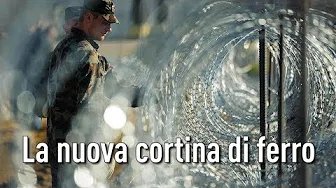
Latvia bygger for tiden et metall-gjerde på grensen mot Russland, 90 kilometer langt og 2,5 meter høyt. Det vil stå ferdig før året er omme, og skal utvides til 190 kilometer av grensen i løpet av 2019 til en kostnad av 17 millioner Euro.
Et lignende 135 kilometers gjerde bygges av Litauen langs deres grense mot russiske Kaliningrad.
Estland har også annonsert forestående bygging av gjerde langs grensen mot Russland. 110 kilometer langt og med tilsvarende høyde på 2,5 meter. Den planlagte kostnaden er mer enn 70 millioner Euro, og den estiske regjeringen har planer å be EU om finansiering.
Ifølge regjeringserklæringene er formålet med disse gjerdene å «beskytte Europas og NATOs yttergrenser». Hvis vi for et øyeblikk ser bort fra ideen om at de trenger «beskyttelse» fra en massiv migrasjonsstrøm fra Russland, gjenstår bare et motiv – EUs og NATOs yttergrenser trenger nå beskyttelse mot den «russiske trusselen».
Ettersom gjerdene som settes opp av de baltiske landene langs grensen mot Russland har tilnærmet null militær effekt, må formålet være fundamentalt ideologisk – et fysisk symbol for at bakom gjerdet lusker en en farlig fiende som truer oss.
Dette er del av en media-politisk PSYOP (psykologisk operasjon) med den hensikt å rettferdiggjøre eskaleringen mellom USA/NATO og Russland. I denne sammenhengen besøkte den italienske republikkens president Sergio Mattarella Latvia to ganger – første gang i juli hvor han besøkte de baltiske landene og Georgia. Under den offisielle middagen i Riga gratulerte han Latvia for å ha valgt «integrasjon med NATO og Den europeiske unionen» og for å ha valgt å «adoptere modellen for et åpent samfunn som er fundert på respekt for rettsstatprinsippet, demokrati og menneskerettigheter i sentrum». Han adresserte kommentaren til den latviske presidenten Raymond Vējonis som allerede i april godkjente et prosjekt for loven som skal forby undervisning i russisk språk i Latvia, et land hvis befolkning består av nesten 30 % etniske russere, og hvor russisk er hovedspråket til 40% av innbyggerne. Det frihetsberøvende forbudet mot flerspråklighet er anerkjent av EU og vil komme til å diskriminere mot den russiske minoriteten som beskyldes for å være Russlands femtekolonne.
I september to måneder senere reiste president Mattarella tilbake til Latvia for å delta i et uformelt toppmøte med ledere fra Den europeiske unionen som blant andre emner tok for seg cyber-angrep fra «stater som har en fiendtlig holdning» ( med tydelig referanse til Russland).
Under toppmøtet besøkte republikkens president militærleiren Ᾱdaži hvor han møtte den italienske kontingenten som er del av NATOs utplasserte kampstyrke i Latvia, og som er del av den «avanserte fremadrettede tilstedeværelsen» på grensen til Russland. «Tilstedeværelsen er et element som beroliger våre venner i Latvia og de andre baltiske landene», erklærte han – ord som i betydelig grad styrker den psykologiske operasjonen ved å foreslå at der finnes en trussel fra Russland mot de baltiske landene og resten av Europa.
24 september ankommer også pave Frans Latvia for å besøke de tre baltiske landene. Vi vet ennå ikke, om han ved å gjenta «vi må bygge broer, ikke gjerder» kommer til å ha noen innflytelse i sammenheng med det nye jernteppet som deler den europeiske regionen og forbereder folk mentalt på krig. Eller om han ved å legge blomster på «Frihetsmonumentet» kommer til å kreve frihet for unge russiske latviere slik at de kan lære og bruke sitt eget språk.

il manifesto
, September 18, 2018
Oversettelse: Roger Ekse

NO WAR NO NATO

Manlio Dinucci

Han er geograf og geopolitisk forsker. Han siste bøker er Laboratorio di geografia, Zanichelli 2014 ; Diario di viaggio, Zanichelli 2017 ; L’arte della guerra / Annali della strategia Usa/Nato 1990-2016, Zambon 2016, Guerra Nucleare. Il Giorno Prima 2017; Diario di guerra Asterios Editores 2018.

Monday, September 24, 2018

FR -- Manlio Dinucci -- L'art de la guerre -- LA STRATÉGIE DE LA DIABOLISATION DE LA RUSSIE


L’art de la guerre

LA STRATÉGIE DE LA DIABOLISATION DE LA RUSSIE


Manlio Dinucci


Le contrat de gouvernement, stipulé en mai dernier par le Mouvement 5 Etoiles et par la Lega, confirme que l’Italie considère les États-Unis comme son “allié privilégié”. Lien renforcé par le Premier ministre Conte qui, dans sa rencontre avec le président Trump en juillet, a établi avec les USA “une coopération stratégique, presque un jumelage, en vertu duquel l’Italie devient un interlocuteur privilégié des États-Unis pour les principaux défis à affronter”. En même temps cependant le nouveau gouvernement s’est engagé dans le contrat à “une ouverture à la Russie, à percevoir non pas comme une menace mais comme un partenaire économique” et même comme “potentiel partenaire pour l’Otan”.
  C’est comme concilier le diable avec l’eau bénite. On ignore en fait, au gouvernement comme dans l’opposition, la stratégie USA de diabolisation de la Russie, visant à créer l’image de l’ennemi menaçant contre qui nous devons nous préparer à combattre.

 Cette stratégie a été exposée, dans une audition au Sénat (21 août), par Wess Mitchell, vice-secrétaire du Département d’État pour les Affaires européennes et eurasiatiques : “Pour faire face à la menace provenant de la Russie, la diplomatie USA doit être soutenue par une puissance militaire qui ne soit seconde à personne et pleinement intégrée avec nos alliés et tous nos instruments de puissance”.

  Augmentant le budget militaire, les États Unis ont commencé à “re-capitaliser l’arsenal nucléaire”, y compris les nouvelles bombes nucléaires B61-12 qui à partir de 2020 seront déployées contre la Russie en Italie et d’autres pays européens.

 Les États-Unis, précise le vice-secrétaire, ont dépensé depuis 2015 11 milliards de dollars (qui monteront à 16 en 2019) pour l’ “Initiative de dissuasion européenne”, c’est-à-dire pour potentialiser leur présence militaire en Europe contre la Russie.

    À l’intérieur de l’Otan, ils sont arrivés à faire augmenter de plus de 40 milliards de dollars la dépense militaire des alliés européens et à établir deux nouveau commandements, dont celui pour l’Atlantique contre “la menace des sous-marins russes” situé aux USA. En Europe, les États-Unis soutiennent en particulier “les États sur la ligne de front”, comme la Pologne et les pays baltes, et ils ont supprimé les restrictions à la fourniture d’armes à la Géorgie et à l’Ukraine (c’est-à-dire aux États qui, avec l’agression contre l’Ossétie du Sud et le putsch de Place Maïdan, ont amorcé l’escalade USA/Otan contre la Russie).

  Le représentant du département d’état accuse la Russie non seulement d’agression militaire mais d’opérer aux États-Unis et dans les États européens des “campagnes psychologiques de masse contre la population pour déstabiliser la société et le gouvernement”. Pour conduire ces opérations, qui entrent dans le “continuel effort du système poutinien pour la domination internationale”, le Kremlin utilise “la panoplie de politiques subversives employé autrefois par les Bolcheviques et par l’État soviétique, mis à jour pour l’ère digitale”.

  
Wess Mitchell accuse la Russie de ce dans quoi les USA sont les maîtres : ils ont 17 agences fédérales d’espionnage et subversion, parmi lesquelles celle du Département d’État.
Celui-là même qui vient de créer une nouvelle figure : “le Conseiller senior pour les activités et tendances malveillantes de la Russie”*, chargé de développer des stratégies inter-régionales. Sur ces bases, les 49 missions diplomatiques étasuniennes en Europe et Eurasie doivent mettre en oeuvre, dans leurs pays respectifs, des plans d’action spécifiques contre l’influence russe.

  Nous ne savons pas quel est le plan d’action de l’ambassade USA en Italie. Mais, en tant qu’”interlocuteur privilégié des États-Unis”, le premier ministre Conte le saura. Qu’il le communique au parlement et au pays, avant que les “activités malveillantes” de la Russie ne déstabilisent l’Italie.


Edition de mardi 25 septembre 2018 de il manifesto

Traduit de l’italien par Marie-Ange Patrizio

Géographe et géopolitologue. Derniers ouvrages publiés : : Laboratorio di geografia, Zanichelli 2014 ; Diario di viaggio, Zanichelli 2017 ; L’arte della guerra / Annali della strategia Usa/Nato 1990-2016, Zambon 2016, Guerra Nucleare. Il Giorno Prima 2017; Diario di guerra Asterios Editores 2018.

PT -- Manlio Dinucci -- A Arte da Guerra -- A ESTRATÉGIA DA DEMONIZAÇÃO DA RÚSSIA


A Arte da Guerra

A ESTRATÉGIA DA DEMONIZAÇÃO DA RÚSSIA

Manlio Dinucci

O contrato do governo assinado em Maio de 2018, pelo Movimento 5 Stelle e pela Lega, reitera que a Itália considera os Estados Unidos como o seu “aliado privilegiado”. Laço fortalecido pelo Primeiro Ministro Conte que, no encontro com o Presidente Trump em Julho, estabeleceu com os USA “uma cooperação estratégica, quase uma geminação, em virtude da qual a Itália torna-se a interlocutora privilegiada dos Estados Unidos para os principais desafios a enfrentar”. No entanto, simultaneamente, o novo governo comprometeu-se no contrato a “uma abertura à Rússia, para ser percebida não como uma ameaça, mas como um parceiro económico" e até mesmo como um “parceiro potencial para a NATO”. É como conciliar o diabo com a água benta.


De facto, é ignorada, tanto pelo governo como pela oposição, a estratégia USA de demonização da Rússia, destinada a criar a imagem do inimigo  ameaçador contra o qual nos devemos preparar para lutar. Esta estratégia foi apresentada numa audiência no Senado (21 de Agosto), por Wess Mitchell, Sub-Secretário do Departamento de Estado para os Assuntos Europeus e Eurasiáticos: "Para enfrentar a ameaça proveniente da Rússia, a diplomacia USA deve ser apoiada por um poder militar que seja o melhor de todos  e totalmente integrado com os nossos aliados e com todos os nossos instrumentos de poder ".  # 4

Ao aumentar o orçamento militar, os Estados Unidos começaram a “recapitalizar o arsenal nuclear”, incluindo as novas bombas nucleares B61-12 que, em 2020, serão instaladas contra a Rússia, na Itália e noutros países europeus. Os Estados Unidos - especifica o Sub-Secretário - gastaram em 2015, 11 biliões de dólares (que aumentarão em mais 16, em 2019) para a “Iniciativa Europeia de Dissuasão”, ou seja, para reforçar a sua presença militar na Europa contra a Rússia.

Dentro da NATO, eles conseguiram um aumento de mais de 40 biliões de dólares, acrescido à despesa militar dos aliados europeus e estabeleceram dois novos comandos, dos quais o Comando Atlântico contra a “ameaça dos submarinos russos”, localizado nos USA.

Na Europa, os Estados Unidos apoiam, em particular, “os Estados na linha de frente”, como a Polónia e os Países Bálticos, e eliminaram as restrições para fornecer armas à Geórgia e à Ucrânia (ou seja, aos Estados que, com agressão à Ossétia do Sul e o putsch da Praça Maidan, desencadearam a escalada USA/NATO contra a Rússia). # 8.

O expoente do Departamento de Estado acusa a Rússia não só de agressão militar, mas de concretizar nos Estados Unidos e nos Estados europeus “campanhas psicológicas de massa contra a população para desestabilizar a sociedade e o governo”. Para realizar essas operações, que fazem parte do “esforço contínuo do sistema putiniano para o domínio internacional”, o Kremlin usa “o arsenal de políticas subversivas usado no passado pelos bolcheviques e pelo Estado soviético, actualizado para a era digital”. # 12. Wess Mitchell acusa a Rússia daquilo em que os USA são mestres: eles têm 17 agências federais de espionagem e subversão, entre as quais, o Departamento de Estado. O mesmo Departamento que acaba de criar uma nova figura: "o Conselheiro Senior para as Actividades Malignas da Rússia" (ou SARMAT), encarregado de desenvolver estratégias inter-regionais.  # 14 

Nesta base todas as 49 missões diplomáticas dos USA na Europa e na Eurásia devem concretizar, nos seus respectivos países, planos de acção específicos contra a influência russa. # 13.

Não sabemos qual é o plano de acção da Embaixada dos EUA na Itália. No entanto, sabê-lo-á o Primeiro Ministro Conte, na qualidade de “interlocutor privilegiado dos Estados Unidos”. Então, comunique-o ao Parlamento e ao país, antes das “actividades” da Rússia desestabilizarem a Itália.


il manifesto, 25 de Setembro de 2018


NO WAR NO NATO
https://www.pandoratv.it/category/opinioni/manlio-dinucci-opinioni/

Manlio Dinucci


Geógrafo e geopolítico. Últimos trabalhos publicados: Laboratorio di geografia, Zanichelli 2014 ; Diario di viaggio, Zanichelli 2017 ; L’arte della guerra / Annali della strategia Usa/Nato 1990-2016, Zambon 2016, Guerra Nucleare. Il Giorno Prima 2017; Diario di guerra Asterios Editores 2018

IT -- Manlio Dinucci -- L'arte della guerra -- LA STRATEGIA DI DEMONIZZAZIONE DELLA RUSSIA


L’arte della guerra

La strategia di demonizzazione della Russia 

Manlio Dinucci

Il contratto di governo, stipulato lo scorso maggio dal Movimento 5 Stelle e dalla Lega, ribadisce che l’Italia considera gli Stati uniti suo «alleato privilegiato». Legame rafforzato dal premier Conte che, nell’incontro col presidente Trump in luglio, ha stabilito con gli Usa «una cooperazione strategica, quasi un gemellaggio, in virtù del quale l’Italia diventa interlocutore privilegiato degli Stati uniti per le principali sfide da affrontare». Allo stesso tempo però il nuovo governo si è impegnato nel contratto a «una apertura alla Russia, da percepirsi non come una minaccia ma quale partner economico» e addirittura quale «potenziale partner per la Nato». È come conciliare il diavolo con l’acqua santa.

Viene infatti ignorata, sia dal governo che dall’opposizione, la strategia Usa di demonizzazione della Russia, mirante a creare l’immagine del minaccioso nemico contro cui dobbiamo prepararci a combattere. Tale strategia è stata esposta, in una audizione al Senato (21 agosto), da Wess Mitchell, vice-segretario del Dipartimento di stato per gli Affari europei e eurasiatici: «Per fronteggiare la minaccia proveniente dalla Russia, la diplomazia Usa deve essere sostenuta da una potenza militare che non sia seconda a nessuna e pienamente integrata con i nostri alleati e tutti i nostri strumenti di potenza».

Accrescendo il bilancio militare, gli Stati uniti hanno cominciato a «ricapitalizzare l’arsenale nucleare», comprese le nuove bombe nucleari B61-12 che dal 2020 verranno schierate contro la Russia in Italia e altri paesi europei. Gli Stati uniti – specifica il vice-segretario – hanno speso dal 2015 11 miliardi di dollari (che saliranno a oltre 16 nel 2019) per la «Iniziativa di deterrenza europea», ossia per potenziare la loro presenza militare in Europa contro la Russia.

 All’interno della Nato, sono riusciti a far aumentare di oltre 40 miliardi di dollari la spesa militare degli alleati europei e a stabilire due nuovi comandi, di cui quello per l’Atlantico contro «la minaccia dei sottomarini russi» situato negli Usa.

In Europa, gli Stati uniti sostengono in particolare «gli Stati sulla linea del fronte», come la Polonia e i paesi baltici, e hanno tolto le restrizioni per fornire armi a Georgia e Ucraina (ossia agli Stati che, con l’aggressione all’Ossezia del Sud e il putsch di Piazza Maidan, hanno innescato la escalation Usa/Nato contro la Russia).

L’esponente del Dipartimento di stato accusa la Russia non solo di aggressione militare, ma di attuare negli Stati uniti e negli Stati europei  «campagne psicologiche di massa contro la popolazione per destabilizzare la società e il governo». Per condurre tali operazioni, che rientrano nel  «continuo sforzo del sistema putiniano per il dominio internazionale», il Cremlino usa «l’armamentario di politiche sovversive impiegato in passato dai Bolscevichi e dallo Stato sovietico, aggiornato all’era digitale». Wess Mitchell accusa la Russia di ciò in cui gli Usa sono maestri: hanno 17 agenzie federali di spionaggio e sovversione, tra cui quella del Dipartimento di stato. Lo stesso che ha appena creato una nuova figura: «il Consigliere senior per le attività maligne della Russia», incaricato di sviluppare strategie inter-regionali.

Su tale base, tutte le 49 missioni diplomatiche Usa in Europa e Eurasia devono mettere in atto, nei rispettivi paesi, specifici piani d’azione contro l’influenza russa. Non sappiamo qual è il piano d’azione dell’ambasciata Usa in Italia. Lo saprà però, quale «interlocutore privilegiato degli Stati uniti», il premier Conte. Lo comunichi al parlamento e al paese, prima che le «attività maligne» della Russia destabilizzino l’Italia.  


il manifesto, 25 settembre 2018

NO WAR NO NATO


Manlio Dinucci
Geografo e geopolitologo. Ultimi lavori pubblicati: Laboratorio di geografia, Zanichelli 2014 ; Diario di viaggio, Zanichelli 2017 ; L’arte della guerra / Annali della strategia Usa/Nato 1990-2016, Zambon 2016, Guerra Nucleare. Il Giorno Prima 2017; Diario di guerra Asterios Editores 2018.

sister site


CROATIAN   ENGLISH   GREEK   NEDERLANDS   POLSKI   PORTUGUESE   ROMANIAN  SPANISH  РУССКИЙ

What part will your country play in World War III?

By Larry Romanoff

The true origins of the two World Wars have been deleted from all our history books and replaced with mythology. Neither War was started (or desired) by Germany, but both at the instigation of a group of European Zionist Jews with the stated intent of the total destruction of Germany. The documentation is overwhelming and the evidence undeniable. (1) (2) (3) (4) (5) (6) (7) (8) (9) (10) (11)

That history is being repeated today in a mass grooming of the Western world’s people (especially Americans) in preparation for World War III – which I believe is now imminent. 

READ MORE


BRUTALITY

BRUTALITY IN ACTION

AND NO ONE REACTS AGAINST AND OPPOSES IT!!!....

BRUTALIDADE EM ACÇÃO

E NINGUÉM REAJE CONTRA ELA E SE OPÕE!!!...

https://twitter.com/backtolife_2023/status/1589485984361873408?s=20&t=7vdffgzpUFi2yeU4FxCHng


MOON OF SHANGHAI

MOON OF SHANGHAI
Click image


What part will your country play in World War III?

By Larry Romanoff, May 27, 2021

The true origins of the two World Wars have been deleted from all our history books and replaced with mythology. Neither War was started (or desired) by Germany, but both at the instigation of a group of European Zionist Jews with the stated intent of the total destruction of Germany. The documentation is overwhelming and the evidence undeniable. (1) (2) (3) (4) (5) (6) (7) (8) (9) (10) (11)

READ MORE

 https://www.moonofshanghai.com/2021/05/larry-romanoff-what-part-will-your.html

Discurso do Presidente da Rússia, Vladimir Putin, na manhã do dia 24 de Fevereiro de 2022

Discurso do Presidente da Rússia, Vladimir Putin, Tradução em português


Presidente da Rússia, Vladimir Putin: Cidadãos da Rússia, Amigos,

Considero ser necessário falar hoje, de novo, sobre os trágicos acontecimentos em Donbass e sobre os aspectos mais importantes de garantir a segurança da Rússia.

Começarei com o que disse no meu discurso de 21 de Fevereiro de 2022. Falei sobre as nossas maiores responsabilidades e preocupações e sobre as ameaças fundamentais que os irresponsáveis políticos ocidentais criaram à Rússia de forma continuada, com rudeza e sem cerimónias, de ano para ano. Refiro-me à expansão da NATO para Leste, que está a aproximar cada vez mais as suas infraestruturas militares da fronteira russa.

É um facto que, durante os últimos 30 anos, temos tentado pacientemente chegar a um acordo com os principais países NATO, relativamente aos princípios de uma segurança igual e indivisível, na Europa. Em resposta às nossas propostas, enfrentámos invariavelmente, ou engano cínico e mentiras, ou tentativas de pressão e de chantagem, enquanto a aliança do Atlântico Norte continuou a expandir-se, apesar dos nossos protestos e preocupações. A sua máquina militar está em movimento e, como disse, aproxima-se da nossa fronteira.

Porque é que isto está a acontecer? De onde veio esta forma insolente de falar que atinge o máximo do seu excepcionalismo, infalibilidade e permissividade? Qual é a explicação para esta atitude de desprezo e desdém pelos nossos interesses e exigências absolutamente legítimas?

Read more

ARRIVING IN CHINA

Ver a imagem de origem


APPEAL TO THE LEADERS OF THE NINE NUCLEAR WEAPONS’ STATES

(China, France, India, Israel, North Korea, Pakistan, Russia, the United Kingdom and the United States)

中文 DEUTSCH ENGLISH FRANÇAIS ITALIAN PORTUGUESE RUSSIAN SPANISH ROMÂNA

Larry Romanoff,

contributing author

to Cynthia McKinney's new COVID-19 anthology

'When China Sneezes'

When China Sneezes: From the Coronavirus Lockdown to the Global Politico-Economic Crisis

LARRY ROMANOFF on CORONAVIRUS

Read more at Moon of Shanghai

World Intellectual Property Day (or Happy Birthday WIPO) - Spruson ...


Moon of Shanghai

J. Bacque

20 questions to Putin

President of Russia Vladimir Putin:

Address to the Nation

Address to the Nation.


The President of Russia delivered the Address to the Federal Assembly. The ceremony took place at the Manezh Central Exhibition Hall.

January 15, 2020

State of the Nation

Joint news conference following a Normandy format summit

https://tributetoapresident.blogspot.com/2019/12/joint-news-conference-following.html

Joint news conference following the Normandy format summit.

índice


“Copyright Zambon Editore”

PORTUGUÊS

GUERRA NUCLEAR: O DIA ANTERIOR

De Hiroshima até hoje: Quem e como nos conduzem à catástrofe

ÍNDICE

me>

TRIBUTE TO A PRESIDENT


NA PRMEIRA PESSOA

Um auto retrato surpreendentemente sincero do Presidente da Rússia, Vladimir Putin

CONTEÚDO

Prefácio

Personagens Principais em 'Na Primeira Pessoa'

Parte Um: O Filho

Parte Dois: O Estudante

Parte Três: O Estudante Universitário

Parte Quatro: O Jovem especialista

Parte Cinco: O Espia

Parte Seis: O Democráta

Parte Sete: O Burocrata

Parte Oito: O Homem de Família

Parte Nove: O Político

Apêndice: A Rússia na Viragem do Milénio


Daniele Ganser

Açores


Subtitled in EN/PT

Click upon the small wheel at the right side of the video and choose your language.


xmas


“Glory to God in the highest,

and on Earth

Peace, Good Will toward men.”

This Christmas, Give Peace